Houston septic repair & pumping
Septic Pumping vs Cleaning: What Is the Difference?
Companies do not always mean the same thing by “pumping” and “cleaning.” Compare the work in writing before comparing the price.
Repair, pumping, inspection, installation, and urgent septic help.
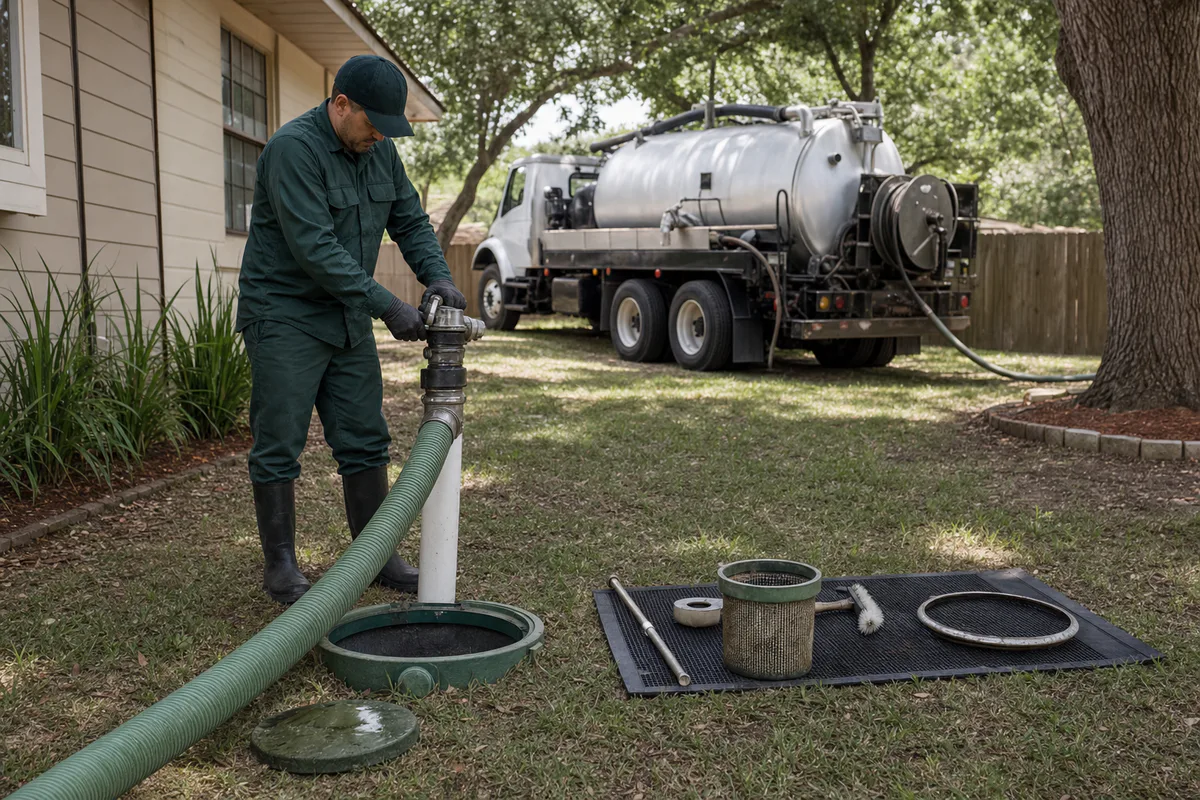
Ask three septic companies to define “cleaning” and you may get three answers. One means a standard pump-out. Another includes an effluent-filter rinse. A third is selling a wall wash. The label is less useful than the written scope.
What Is Septic Pumping?
Septic pumping is the basic service. A truck arrives, inserts a large vacuum hose into your tank through the access lid, and sucks out the liquid effluent and settled sludge. The waste is hauled to a licensed disposal facility.
EPA guidance focuses on measuring sludge and scum, pumping when those layers reach specified levels, checking for leaks, and recording the tank condition. It does not define a universal premium “cleaning” package.
What Is Septic Cleaning?
Some providers use cleaning to mean extra washing, filter service, or a more detailed inspection. Those tasks may be useful in a particular system, but the word alone does not promise them.
Ask the contractor to specify which compartments will be pumped, whether the effluent filter will be serviced, how the baffles will be checked, and what will appear in the service report.
Side-by-Side Comparison
| Service | Pumping | Cleaning |
|---|---|---|
| Removes liquid and sludge | Yes | Yes |
| Tank-wall rinsing | Not defined by label | Not defined by label |
| Baffle inspection | Ask provider | Ask provider |
| Effluent filter cleaning | May be included | May be included |
| Time on site | Depends on access and tank | Depends on added scope |
| Houston-area cost | Quote required | Quote required |
When is a standard pump-out enough?
Pumping is the right choice when:
- Your tank has been pumped or cleaned within the last 3 to 5 years
- You are on a regular maintenance schedule
- You have no active symptoms (no slow drains, no smells, no gurgling)
- The last service report showed no issues with baffles or filters
If the system has a clear service history and the inspection does not find another issue, a standard pump-out may be all that is needed.
When should you consider added work?
Ask about added work when:
- It has been more than 5 years since the last service
- You just bought the home and do not know the service history
- You are noticing early warning signs like slow drains or mild odors
- The last technician noted heavy sludge buildup or scum accumulation
- The inspection finds a clogged effluent filter or a component that needs attention
Do not approve an undefined upgrade. Ask what was observed, what additional task is proposed, and how that task changes the outcome.
Why can problems return after pumping?
A pump-out removes material from the tank. It does not repair a failed pump, cracked pipe, damaged baffle, or saturated drainfield. If symptoms return quickly, the next step is diagnosis, not automatically another cleaning package. The seven repair warning signs can help you describe what changed.
What About "Septic Tank Cleanout"?
You might see the term "septic tank cleanout" when searching online. This is sometimes used interchangeably with cleaning, and sometimes it refers to the cleanout access point (the pipe or fitting that gives access to the tank). If a company quotes you for a "cleanout," ask specifically what is included. Is it just pumping? Is it a full cleaning with wall wash and baffle inspection? Get it in writing before the truck arrives.
What should you request?
Request a complete written scope: access, compartments pumped, disposal, sludge and scum notes, filter work, basic condition findings, and any exclusions. That list makes two quotes comparable even when the companies use different labels.
Sources
- U.S. EPA, “How to Care for Your Septic System” — pump-out thresholds, inspections, and service records; retrieved 2026-07-27.
- U.S. EPA, “Frequent Questions on Septic Systems” — inspection components and maintenance intervals; retrieved 2026-07-27.
- TCEQ, “Maintenance of On-Site Sewage Facilities” — conventional and aerobic maintenance guidance; retrieved 2026-07-27.
Pumping vs Cleaning FAQs
What is the difference between septic pumping and septic cleaning?
The labels are not standardized. A proper pump-out removes accumulated material and should include basic condition observations. Some companies use cleaning for extra washing or filter work, so ask for the written scope.
How much more does cleaning cost than pumping?
There is no standard surcharge because companies define cleaning differently. Compare written scopes rather than comparing the labels alone.
How often should I get a full cleaning vs just pumping?
Do not use an automatic every-other-pump rule. Ask what the inspection found and approve extra work only when the tank condition, filter, or components justify it.
Does cleaning remove more waste than pumping?
It may, depending on the process, but a spotless-looking tank is not the goal. The useful questions are whether accumulated solids were removed and whether the tank, outlet, filter, and drainfield showed problems.
Schedule Septic Service
Share the essentials and we’ll follow up about the right septic service.
Comparing Pumping Quotes?
Use the request form to describe your tank, access, and service history.
Get a free estimate